Showing posts with label OWB. Show all posts

Saturday, November 26, 2022

Assault on Pillbox 12: an OWB "Trial by Fire" Funnel attempt

This post is based on a recent "one-shot" session I ran my group through using the "Trial by Fire" rules from OWB and the "Assault on Pillbox 12" scenario from the "Normandy Breakout" supplement. We were a regular player down (the one that is the designated group leader), so it made for an interesting diversion and helped me with some of the individual personality dynamics... 

Into the Jaws of Death...

So Why a D-Day Scenario? 

So when I start a new group of players or a new campaign arc for existing ones, I like to throw the action straight at them - not always a combat situation, but often something dangerous - they begin in media res and need to quickly sort themselves out - it's one of The Lazy DM's tactics I like to use repeatedly. I thought this would work even better for a one-shot and the nature of a funnel is that things move fast and improvisation is the name of the game...

Assault on Pillbox 12 is an almost scene-by-scene simulation of the Omaha beach landing scene from the film "Saving Private Ryan", so I thought it would be ideal, if somewhat intense... (trigger warning)

I mean the first few minutes really kick things off and get the adrenaline going - I recommended the players watch that extended scene from Saving Private Ryan if they could to get into the mood.

Amusingly, only one of the three players had actually seen the film, which I think amplified the whole effect and created a very compelling sense of confusion and urgency.

How to Play OWB "Trial by Fire" 

Effectively the rules on pages 42-43 of the OWB Corebook are a type of funnel, well at least a "mini-funnel" in the spirit of DCC or similar. A bunch of unskilled 0th-level characters are thrown into a dangerous situation and the survivors develop relationships, back stories, and an idea of their skill aptitudes and personality quirks during the "funnel session".

Character Names 

Rather than actual proper names, I just asked the players to pick the appropriate style first names (and optionally surnames) starting with the same letter in the sequence. So for instance we first had:

    Aaron
    Bob
    Colin

Then as each character dies, moving down the alphabet:

    Dave
    Eliot
    Fred
    George

... and so on, cycling through the letters. 

This prevented interruption of play, and to further keep up the momentum I had each new character appear as a new grunt running up to the spot the player's last character died or near enough (emulating respawning in FPS games eg Call of Duty and similar) and falling in.

The only hesitation was choosing the weapon loadout from the three choices (Large Rifle (M1 Garand) + 4 grenades / SMG + 4 grenades / Heavy Weapon + only 2 grenades) and the preferred Physical Stat (STR or DEX or CON). This rolled through pretty quickly after the first few "changeovers".

After a player had three characters die, as a variant rule given the lethality of Assault on Pillbox 12 for zero-level characters, I allowed for 4th and subsequent characters but restricted the weapon choice to Large Rifle but players could scavenge from their fallen comrades.     

In the session I ran with my group as a "one-shot" , only the character that started with Colin had a surving character (Leonard) from his three initial "lives", the other players had one surviving character (Mike) with 4 dead, and no surviving character and 7 dead. So in total, 13 dead and 2 surviving 0th level characters from the "funnel", one who stood out as a possible Tactician, the other was played more as a Grunt than anything (survived jumping on a grenade with a helmet).

Using Allied NPCs 

I used a similar strategy with any Allied NPCs, using their first names A, B, C ... etc, but in retrospect, it would have been better to use surnames for realism, and will do that for any subsequent sessions. An alternative would be to use a name generator such as this one (in advance) and have a ready-made list

So I didn't use any officers, because I wanted to let the players attempt to rally the remnants and didn't want to railroad them, but unfortunately, they just randomly headed off in a group by themselves... LOL. 

However, I did throw in a brief encounter with a combat medic moving along the lines, healing up the troops and any wounded player characters, and some combat engineers with Bangalores. I left it pretty freeform and let the chaos reign.

For a future session, I'd run these a bit more developed (see below).

Running the Beach Landing

Just like in the movie, there's a lot going on during the beach landing and it can be confusing... this is inherent to the chaos of the assault but can make it difficult to run easily even with the "mass combat lite" approach used in the scenario, so I broke things down into a couple of actions I needed to do. 

I first decided to push the dice rolling back onto the players to increase their buy and in and provide a sense of urgency and hopefully retain agency... this worked so well though that it resulted in the players running off in different directions without coordination - somewhat less than optimal, but led to amusing outcomes and I think truly reflective of the potential for panic.

To achieve this I made each character roll TWO d6s each "round" (preferably different colours unless using Discord or Roll 20 etc) while moving to the base of the cliff. Depending on their choices and the Bangalores, a given character can reach the cliff base in as little as 6 "rounds" but it will most likely take longer than that to cross the distance into the relative safety of the  

The first d6  is to check if they were hit by "enemy fire" - on a 1, that is the main event for that round and the second d6 is used to determine what they are hit by (Normandy Breakout, p4). 

If I'd thought of it, I would have added a d20 save as most of the time they ended up having some sort of cover they could use or flong themselves towards - one of the players worked out how to make a short macro for Roll 20 which we used, so that would be the way forward I suspect.

                Use this string:     /roll 2d6+d20     (copy and paste)

Secondly, I created a "DM Playsheet" from the map that had all the main information to hand:

DM Playsheet for Assault on Pillbox 12

This has everything I need in the scene but is not covered by the basic OWB rules.

I also found this elevation plan that gives an idea of the beach terrain for better visualisation and can be handed to as a printout for players or sent as an image over Discord / Roll 20 or other VTT:


And a nifty diagram and photo of a Landing Craft (aka "Higgins Boat") to help evoke the initial moments:


Ideas for Repeat Playthrough


I plan to run this again, as it really was a lot of chaotic fun!

It was a great "one-shot" filler for when a player or two is missing, and I can see adding in WW2 style variations (Nazi Super Science, Nazi Occult, etc) or shifting it into a different setting or game system even with a bit of jury rigging. There are definitely a few elements and structural parts that could fit into say a T2k 2nd edition or 4th edition (Free League) game - adjusting some of the "atmospheric" rules for the initial breakout from Escape from Kalisz...

Added Details and Encounters while Crossing the Beach

For future plays, I'll be making it so that if they roll another number than 1, other events happen based on this optional expanded table next time, using the second die to help determine the exact scene the player witnesses:

Table A: Stray Fire & Additional Beach Scenes

1.        Hit by Enemy Fire (1-4 stray fire, 5 MG, 6 explosion) as per p4 
2-3      Just missed by enemy fire (use 2nd die to determine type of enemy fire)
4.        Soldier falls in front of you to enemy fire (use 2nd die to determine type of enemy fire)
5.        Come across a dead body (can use as partial cover for stray fire only) with gear
           + Wire clippers (1-2) / Rocket grapple (3-4) / Weapon upgrade (5-6)
          6.        Officer (1) / Radioman (2) / Sniper (3) / Medic (4) encounter OR soldier falls (5-6)

Officer: will attempt to rally the players and push them towards the next objective by barking orders.  
Radioman: busy trying to communicate about conditions on the beach, characters will hear snatches of communication but be aware that few officers have survived. 
Sniper: can ask to lay down covering fire on an MG nest to avoid if rolls next turn 
Medic: will heal character 1d3 hit points of wounded. If the character is not wounded, the Medic will ask them to help drag a wounded soldier to the closest piece of cover and assist for 1 round. 

This is roughly based on the script of the beach landing scene and the brief encounters of Tom Hank's character, Captain Miller, plus a few other ideas to help the meta-game progress and give the players some hints and the potential to pick up some specific equipment or weapons.


Sunday, October 17, 2021

I'm Still On My Own? Viva La Apocalypse while awaiting my copy of T2k v4.0

The Wasteland of 2022?
Art from Free League (promotional images)


It's been a while since I posted anything T2k related, but this post acts as a partial explanation and has some hints about the future of this blog with the release of the 4th edition. I don't usually seek comments, but given the circumstances, I'd welcome opinions on my intentions from the community!

My current mood for lockdown in Fortress Oz... 

Well not quite perhaps, but down here in Australia shipping is often delayed significantly, so it's unlikely I'll see my Kickstarter T2k v4 boxed set anytime soon sadly. As much as I appreciate the PDFs (alpha and beta), for something like this I feel I need to have the physical product to immerse myself in to study and work through - so I'll keep waiting for now patiently.

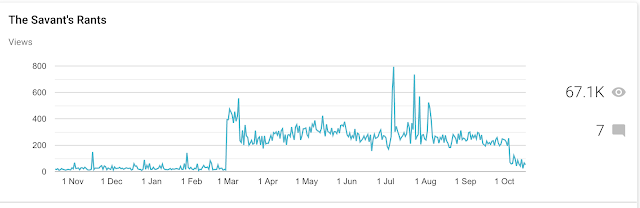
The pandemic has caught all of us up in different ways so it's been a while since I've looked at any of the T2k material I've created and written about on this blog. I was surprised when I came back after about a year to post a player summary for my current 5E group about the Iron Kingdoms, to see that this site has been accessed a *lot* more times than I expected, more than my other RPG blog

So I may have felt like I was still on my own down here in the antipodes, but it was a welcome surprise to find that in March this year, my site has become wildly more popular than previously, with particular popularity in July and August as well which is unprecedented.


Thank you all for your interest in my humble little blog of rantings!

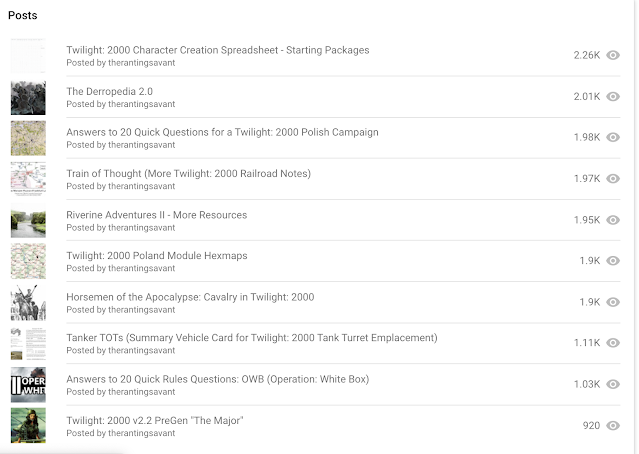
I must say I'm a bit lost as to why as I've been so caught up with life and work that I hadn't been following along with the community much and seem to have missed something... so I had a look at the Top 10 posts accessed in the last 6 months to get some idea of where the interest lay:


Top 10 Posts April to October 2021

So it seems pretty clear, with 7/10 of the top posts directly T2k related, that the interest is likely related to the recent launch of the 4th edition and perhaps people's reactions to (or against that). I'm quite proud of some of the articles in this list, so good to see people are finding them useful.

I am however curious why they are being accessed - whether they are being accessed for use in the new 4th edition or rather being used to support people playing the earlier editions. As noted above, leave a comment on what you have found useful and preferably why. Also if you have any ideas to shed on the site's sudden popularity I'd appreciate it.

As to the other three posts:

So when I do get my boxed set, I'll be returning to revise and expand on my existing T2k articles.

I'll compare the v2.2 mechanics of my older articles and the new 4th edition mechanical interpretations of the setting: character generation, iconic pre-generated NPCs, the Polish campaign and hex maps, trains, cavalry, and of course TOTs. OK maybe some new articles as well, eh? 

Should be fun, I'm looking forward to it.


Tu N'es Pas Tout Seul... Merci!

Oh last, but definitely not least comment. 

Thank you to all you viewers in France.!

Whoever you are and regardless of why because this was a very unexpected audience metric.

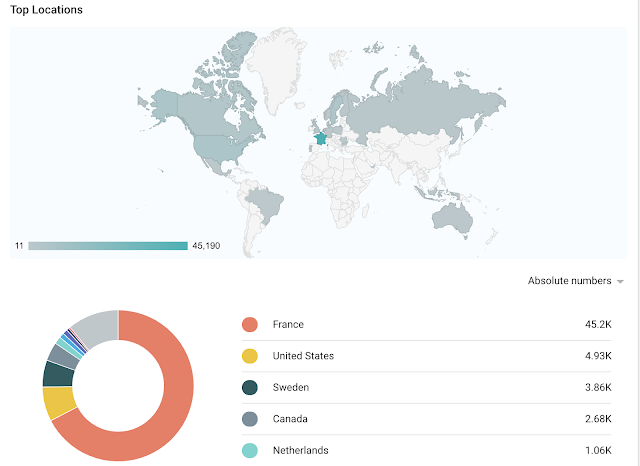
It seems this blog is now significantly more accessed from France than elsewhere by almost an order of magnitude. I really don't understand why to be honest, but although I can understand the content being popular in North America and also Sweden, I'm not quite sure what the "French Connection" is exactly as nothing is in French (my schoolboy French is terrible, Google Translate to the rescue) and nothing on this blog is set in France, unlike my other blog

I'm not aware of French VPNs being suddenly popular either.


6 months of Audience by Origin

So I guess it's Viva La Apocalypse! 

Au revoir. 


Friday, May 10, 2019

Answers to 20 Quick Rules Questions: OWB (Operation: White Box)

I enjoyed answering "20 Quick Rules Questions" for Twilight: 2000 so much that I thought I'd look at answering them for another favourite game of mine that I understand some people have already used successfully as an alternate system for a Twilight: 2000 campaign:  


This is based on the OSR blog post list that I stumbled across - Brendan S. of Necropraxis' 2012 post "20 Quick Rules Questions". Given Operation white Box (OWB) is based on the original edition of Dungeons & Dragons (the Gygax and Arneson one), the answers could provide a useful starting point for new players.

For those of you unfamiliar with this system, it's created by Pete Spahn of Small Niche Games.

Consider downloading the potentially freely available "Pay What You Want" PDF only edition to look over (suggested price $5 USD) or better yet support Pete and buy the actual softcover or hardcover! I'd highly recommend checking out some of the reviews available (such as RPGPundit's reviewRolling Boxcars' reviewthe one over at "Thoughts of a Barbarian" and for those who like videos Ol' Man Grognard's video review or Brendan Goeringer's video review).


Operation: White Box - 20 quick Rules Questions


1. Ability scores generation method?


The standard generation is very "old-school" rolling 3d6 and assigning to the Attributes in order ie. Strength, Intelligence, Wisdom, Constitution, Dexterity, and Charisma (page 2).

There are two other options presented:
"Some Referees allow players to have more flexibility in their choice of class. One option is to roll 3d6 six (6) times and "arrange to taste". This allows the player to place the best rolls on the Attributes that best fit the character concept."

"For particularly heroic campaigns, the Referee might allow players to roll 4d6, dropping the lowest single die and add the remaining dice where they wish. This will lead to characters who are well above most normal individuals in the setting, making them more powerful in play." 

2. How are death and dying handled?


When a character's hit points reach zero, they die of their wounds. Optionally, the Referee may allow that a character becomes unconscious when they reach zero hit points, not dying for another one (1) turn, allowing the rest of the unit to come to their aid.

This rule becomes very significant given that characters in OWB at the "Traditional" level of play use only a 1d6 for their hit points with only a small bonus from abilities using the Universal Attribute Bonus Table (page 5) and/or their chosen class (although a Grunt or Uberlaufer starts with 2 HD). "Heroic" level characters use 1d10 for their hit dice and "Inglorious" level characters roll hit points using 1d20, making for a more cinematic experience as it were... (page 24).

In addition, the maximum level is only 5th level, which effectively means that the maximum hit points for a "named" character is only around 35 unless the optional Advanced Attribute Bonus rule is used (page 6). Sure, most weapons only inflict around 1d6 damage except for heavy weapons but this is significant as characters can potentially be slain by a single bullet at low levels.

Fortunately, Gut checks are allowed when a special operative (PC) tries something beyond the norm and can potentially be considered a chance to avoid death - a character rolls 1D6 and if the roll *less* than their level they succeed (page 40).
"Gut checks should be reserved for the most dire situations, where failure results in serious injury or death. Charging a machinegun nest unscathed through a hail of bullets, picking up three live grenades and tossing them back at the Germans, taking out a Tiger tank with a bazooka, running through a minefield, or crawling to the detonator and blowing the bridge even after being reduced to 0 Hit Points are some examples of gut checks." 


3. What about raising the dead?


This isn't a fantasy game, once a character dies that's it, they're permanently dead.

If using the Nazi Occult mini-setting (pages 150-160), resurrection ritual might be possible through either a Natural Magic or Runic Magic ritual or through some kind of Nazi Superscience technology (pages 146-149).


4. How are replacement PCs handled?


There are no specific guidelines for replacement PCs.


5. Initiative: individual, group, or something else?


Group.

Each party rolls 1d6 - the highest roll wins and the winning party acts first.

In the case of a tie, the parties act simultaneously (pages 44-45).


6. Are there critical hits and fumbles? How do they work?


Yes, as an *optional* rule (page 45).

A roll of 20 can be considered an automatic hit, inflict double damage or hit two opponents at once. A roll of 1 similarly can result in an automatic miss and may result in dropping the weapon, the weapon jamming or the character tripping and falling.


7. Do I get any benefits of wearing a helmet?


A helmet provides a +1 bonus to a character's saving throw vs explosions such as a grenade.


8. Can I hurt my friends if I fire into melee or do something similarly silly?


When firing into a melee, it may be impossible to choose which opponent (or friend) receives the attack and the Referee must determine which random target is struck (page 46).


9. Will we need to run from some encounters, or will we be able to kill everything?


The game includes a specific sidebar to address this: "A Note on Combat Lethality..." (page 55).

"The Referee and the players should be aware that combat in WWII: Operation WhiteBox is fairly lethal. The lack of body armor and the lethality of modern weapons makes even the most unskilled NPC soldier dangerous. The characters are encouraged to avoid pitched battles whenever possible and instead rely on superior tactics such as stealth, ambushes, cover and concealment, and overwhelming firepower to overcome their enemies. If the Referee prefers a more combat-oriented type of game, he is encouraged to look over the Optional Rules for Traditional, Heroic, and Inglorious levels of play on pg. 24." 


10. Level-draining monsters: yes or no?


Not in the basic game.

Ghosts are given as an example monster in the Nazi Occult mini-setting (page 152-153) and can drain one level per attack. Vampires are also presented but don't have level draining powers.


11. Are there going to be cases where a failed save results in PC death?


Possibly, although there is no "save vs death" as such.

There is only a *single* saving throw used by characters "to avoid something terrible happening to them", although different classes receive different bonuses against different threats (page 38).

Saving throws mostly allow half damage - there don't appear to be any instantly lethal standard effects (or spells in the Nazi Occult mini-setting) so a failed save *may* result in PC death if the damage inflicted is high enough. Explosions typically inflict 2d6+2 damage unless a saving throw is made, but given the relatively low hit points of most PCs this can certainly be lethal.

It's noted that being directly hit by a vehicle weapon (autocannon or higher calibre) would be lethal, but that individuals are difficult to target so potential hits from these weapons are treated as explosions above and inflict 2d6+2 damage (halved on a successful saving throw).

The sole exception to the above appears to be the saving throw required to escape a destroyed vehicle before it explodes and instantly kills whoever fails to escape in time (page 59).


12. How strictly are encumbrance & resources tracked?


All equipment has a weight in pounds (lbs). A normal character can carry up to 25lbs of equipment without a Movement penalty;  special operatives (PCs) are conditioned to carry up to 100lbs of equipment without issue (pages 38-39).

Specific equipment such as grenades, explosives and other mission-critical equipment *is* tracked.

Ammunition is suggested to be tracked in the abstract rather than by each round or bullet (page 50).

"The Referee is free to count every round (bullets or shells) if that suits the needs of his game. Otherwise, the Referee can have each character roll 1d6 after every three to five firefights. On a roll of one (1), the character is out of ammo." 


13. What’s required when my PC gains a level? Training? Do I get new spells automatically? Can it happen in the middle of an adventure, or do I have to wait for downtime?


PCs gain a level when they accumulate enough XP, no specific training is required.

This isn't a fantasy game so there are no spells in the default game and magic works somewhat differently in the Nazi Occult mini-setting (pages 155-160).

As XP is gained at the end of a mission, this does not occur in the middle of an adventure (page 39).


14. What do I get experience for?


Experience is awarded as a group when they complete missions, but not only for killing opponents, there are several other potential sources suggested (page 39).

  1. Overcoming or defeating opponents (use HDE/XP values)
  2. Use of Class Abilities to further the story or mission (1d6 x10 XP)
  3. Completing "side missions" (Targets of Opportunity) which thwart German plans (1d6 x25 XP)
  4. Completing assigned missions (1d6 x50 XP)

Individual bonus XP can be awarded by Referees for roleplaying particularly well or taking great risks. In addition, each class have a Prime Attribute that provides additional XP and all characters gain an XP bonus from having Charisma or Wisdom values of 13 or higher.

XP gained for vehicle combat has specific guidelines dividing the XP between both the PCs and the NPC crew in a 2:1 ratio as a group (pages 67-68).


15. How are traps located? Description, dice rolling, or some combination?


There's no specific mechanic for detecting traps, but there are rules for finding Hidden Things - a character has a base chance of success equal to 1 on 1d6 if they move at half their normal Movement rate or less and specifically state they are looking carefully. This can be modified by certain character actions or Class abilities at the Referee's discretion (page 38).

The same mechanic applies to Ambushes (page 50). Snipers have not only an improved chance of spotting an ambush but are also able to conceal themselves more effectively (pages 19-20).


16. Are retainers encouraged and how does morale work?


There are no specific rules for retainers and hirelings. The Charmer, MaquisSniper and Uberlaufer gain a small number of loyal NPC followers at 3rd and higher levels (pages 14-24).

A Tactician similarly gains a company, division or special forces unit at 3rd level (page 21). 

Morale is left to the Referee's discretion (page 53):

"The majority of people in the world will not continue to fight a hopeless battle, seeking to retreat, surrender, or flee if they can. Only rarely do people fight to the death. The Referee decides when enemies abandon a battle and retreat, based on the situation and the enemy's intelligence. In some cases, the Referee may have the enemy make a Saving Throw to determine if they will stay or flee, modified by bonuses or other factors."


17. How do I identify magic items?


This is not a fantasy RPG so there are no "magic items" as such in the default game.

If using the Nazi Occult mini-setting, magic items are known as artefakts (page 151). These range from single-shot items that mimic spells, permanent magical items usually in the form of named family heirlooms or unique items, and legendary items with powers determined by the Referee. Given their relative rarity, the latter two types may be relatively easy to identify by their reputation alone.

If using the Nazi Superscience mini-setting, conforming to Clarke's Third Lawsuperscience equipment may partially fill the space of magic items and should be readily identifiable as extraordinary (page 146-147).


18. Can I buy magic items? Oh, come on: how about just potions?


Not in the default game, see #17 above.

In the Nazi Occult setting artefakts may be able to be traded for in return for successfully completed missions. Similarly, superscience equipment may be available to operatives in a Nazi Superscience campaign.


19. Can I create magic items? When and how?


No, see #17 above.

For a Nazi Occult or Nazi Superscience mini-setting, creating or locating significant artefakts or superscience equipment may be a mission in itself - likewise thwarting the creation or activation of Nazi versions may well be an interesting mission concept.


20. What about splitting the party?

(Note this is my "standard" answer as I don't feel it's really a mechanics-specific issue.)

Never split the party. It's always a bad move!

OK, all jokes aside the main issue is the meta-game issue of player boredom while one group or player sits out while the Referee concentrates on the others but this is better discussed elsewhere (such as here, or perhaps here).

However, splitting up the group makes a lot of tactical sense in many situations - scouting, foraging/hunting, maintaining vehicles and other "down-time" activities are often better split up between members of the group given the emphasis on resource tracking including time. So using some of the suggestions in the links above will be useful as it's not an uncommon occurrence.

Sunday, May 5, 2019

OWB T2k - Character Generation


The following are some initial ideas for using the OWB (Operation: White Box) ruleset for a Twilight 2000 campaign. Unless otherwise noted, this is presented as an alternative to the more mechanically complex T2k v2.2 rules that provide significant detail but may be seen as a barrier to new players picking up the game for the first time. 

OWB is based on a much simpler, familiar game system.


War. War Never Changes... but does the ruleset always remains the same?
(Artwork is a mashup of the OWB and T2k v1.0 Covers)


Twilight World Character Creation, OWB style...


In general, as OWB is much simpler and more streamlined than T2k so my comments default to using the RAW ("rules as written") for the game, but there are some distinctive elements from T2k v2.2 that capture the particular feel of the GDW game that I think could be readily incorporated as "optional" rules and are therefore noted below.


Attributes


Replace with the standard OWB Abilities; AGL becomes Dexterity, EDU becomes Wisdom.

As T2k v2.2 uses a 1 to 10 scale, halve all T2k v2.2 related formulas when using OWB Abilities instead of Attributes for any non-OWB based mechanics used.

Use one of the following approaches:

  • Random Generation: In this method, each Ability is determined by rolling 4d6-4 (reroll any roll that would result in a 0 Ability score). This gives a range of from 1 to 20 for each Ability. A player who rolls attributes totalling less than 60 points may add attribute points (allocated as he sees fit) to bring the total up to 60. This way the character is always at least average. 
  • Allocation: Players who choose the allocation method have a total of 64 points to be distributed among their Abilities in any combination they wish. No Ability may have a value of 0 or more than 20.


Nationality & Languages


Pick a Nationality as per OWB, pages 8 and 9. Substitute "Soviet" for Russian - this reflects either Russian, Polish, or other Eastern Bloc origin personnel. Such characters can only choose to be Partisans (if Polish in the default setting) or Defectors (if Russian or other Eastern Bloc see below) and cannot choose one of the basic OWB classes.

Polish or other Eastern bloc characters are treated as "European" for the purposes of determining their fluency and number of additional languages. Russian characters, however, begin only with fluency in Russian (F) and only basic fluency (B) in one other language unless they have high Intelligence.


Terms (and Professions)


OWB does not use Terms to generate characters, unlike T2k v2.2. The closest correlate is probably character level - each character level reflects up to 4 years in service. A party of mixed character level is possible but it is recommended that the characters are all within 2 levels of each other.

For beginning campaigns, set the party's average character level at between 1st to 3rd level. At the GM's option, a starting character may be 4th level but automatically apply ageing effects to their attributes as if their roll was unfavourable (see Age below).

OWB professions (Pages 9 and 10) provide some background detail but minimal mechanical effect.


Character Classes


The six basic OWB special operative classes: Charmer, Combat Engineer, Grunt, Sniper, Tactician, and Wheelman are available without modification. There's not really a direct OWB equivalent of armor crewman, artillery specialist, combat medic, heavy weapons specialist, or pilot at this stage so creating a character along the lines of these archetypes may require some ingenuity.

The Maquis and Uberlaufer classes are readily modified to reflect non-Western individuals as follows:
Partisan replaces the Maquis class. This reflects Polish (or other Eastern Bloc) civilians siding with the western forces and/or local militia unfriendly to the Soviets. Use the same mechanics except that instead of France, abilities such as Contacts and Resistance Leader mentioning France are linked to the character's country of origin based on their chosen Nationality (default is Poland). 
Defector replaces the Uberlaufer class. This reflects Soviet (Russian, Polish regular or other Warsaw Pact forces) personnel forced into military service that defected early during the Twilight War and have since become incorporated into regular Western (US or German army) units. Replace Wermacht Understanding with Soviet Understanding and Nazi Hate with KGB Hate, modifying the mechanical effects to reflect the appropriate modern groups. Hero's Welcome changes to Defector Leader and  reflect a cohort of more recent defectors that join the character attracted by their fame and deeds rather than individual's from his or her hometown but is otherwise mechanically identical.
Option: non-Western military personnel of the six basic OWB classes are possible as later player characters and recruits as the unit travels through post-war Poland. Such characters gain the equivalent of Soviet Understanding in addition to their usual class abilities, but suffer a -5% XP penalty and may not speak English particularly well. 


Rank


Use the OWB rules on page 10 for simplicity - rank has no real mechanical bearing on *either* game in actual play except for doubling the starting equipment buy allowance in T2k v2.2.

Option: all characters except Defectors (Uberlaufer), Partisans (Maquis), and Tacticians roll 1d6 - on a 6 they are an officer. Defectors and Partisans are never officers. Tacticians also roll 1d6 - on a 4 or greater they are officers and are automatically officers if they start to play at 3rd level or higher.


Contacts


Consider using the general rules from T2k v2.2 but modify as there are no Terms in OWB - add one contact per character level note this may adversely affect the uniqueness of the "Contacts" base ability of the Partisan (aka Maquis / "Resistance Fighter") class.


Initiative (and Panic)


Use the standard OWB rules, rolling 1d6 every round of combat.

Option: use the T2k v2.2 rules based on character generation and NPC classification below:
To determine Initiative, regulars roll 1D6, reservists roll 1D6/2 (round up), and draftees roll 1D6/2 (round down, but re-roll results of 0). Add +1 to this roll for rangers, airborne, special forces, force recon, snipers, and equivalents. Modify by -1 from this roll for support, air force enlisted, aviation enlisted, and military intelligence (but never reduce Initiative below 1). Animals have a base Initiative of 6 unless noted otherwise.
Converting across, OWB Snipers add +1 to the base initiative roll, Charmers and Wheelmen modify by -1 from this roll. For all characters add the character OWB level to the player's Initiative rating instead of tracking experience separately for Initiative. Characters with an Initiative of 5+ gain an additional action per round (see T2k v2.2, page 194).

Panic


If the character is knocked down or surprised, roll a 1D6 and if the result is higher than the character's OWB level, the character is frozen and stunned for a number of rounds equal to the number by which the die roll exceeded the character's level.

Option: the character can make a Saving Throw against being stunned.

Alternative: using the expanded initiative option above opens up the potential of the original Panic rules (T2k v2.2 p197, formerly referred to as the "Coolness Under Fire" mechanic in T2k v1.0 and modified for the later edition):
Whenever a character is knocked down by wound damage (see "Wound Effects and Healing," page 211) or surprised (attacked from an unexpected direction, ambushed, or surprised by an encounter as defined in the encounter rules), there is a chance that he or she will panic. This is not blind panic which sends the character screaming away, but panic which causes him or her to momentarily freeze.

To determine if a PC panics, roll 1D6. If the result is greater than his or her Initiative rating, he or she panics. The PC may not conduct any action for the number of turns by which the die roll exceeds his or her Initiative. However, if the character is forced to freeze for more than one combat turn, he or she may go prone on the second turn and remain there until able to move again. If the character has already conducted his or her action for the turn, the following turn counts as the first turn frozen. If the character has not yet acted in the turn in which he or she panicked, the current turn becomes the first turn frozen.
NPCs have initiative based on their equivalent level (see T2k v2.2 page 139).
For ease of reference, use the following T2k v2.2 values below:

  • Novice NPCs have Initiative 1
  • Expert NPCs have Initiative 3
  • Veteran NPCs have Initiative 4
  • Elite NPCs have Initiative 5

NPCs with OWB professions add their character level to their Initiative as above.


Rads


Civilians roll 1d10 x 1d6. Others roll (2x OWB Level) x 1d6 for a minimum of 1d6 Rads. Radiation rules are otherwise the same as for T2k v2.2 (p242-243) but halve the Constitution score in the formulas (as T2k v2.2 uses a 1 to 10 Attribute scale).

If using the optional expanded Initiative rules above, Rads = (2 x Initiative) x 1d6.

Radiation isn't dealt with in the basic OWB rules, so that will have to be detailed further later.


Age


OWB does not use anything similar to T2k v2.2's 4-year Terms, but the concept of effects beyond age 29 affecting starting characters significantly makes sense. Terms loosely correlate to character level (see above), so requiring Ability loss checks at Level 4 and for each level thereafter as per the table on page 24 of T2k v2.2 makes sense - this encourages low-level play and retiring older characters.

Excerpt from T2k v2.2 Rulebook

The character loses 1 point from the relevant attribute if the 1d10 roll is less than the current level of that attribute. If the roll equals or exceeds the attribute, there is no loss.
 
This check, also called an age saving throw, is made at the end of each term.


Skill- and Attribute- Derived Values


The combat values are irrelevant in an OWB based game (Hit Capacity and Unarmed Combat Damage), but the other derived values are of optional relevance: 
Weight: A character's weight in kilograms is equal to 80 plus two times Strength minus Dexterity [2x(Str - Dex)] +80. This accounts for the difference in Attributes between T2k v2.2 and OWB
Load: in  T2k v2.2 a character may carry, without being heavily burdened, weight in kilograms equal to three times the sum of his Strength and Constitution divided by two (Str + Con) x 3/2 to account for the differing Attribute scale. This is called his normal load - compare to the more generous default 11kg (25lbs) for normal individuals and 45kg (100lbs) for the somewhat cinematic allowance for special operatives (OWB pages 38-39).
Throw Range: the distance (in meters) a character can throw a one-kilogram weight accurately is called his throw range in T2k v2.2. Throw range in OWB is twice the character's Strength (Str x 2) in metres or six times the character's Strength (Str x 6) in feet, depending on which scale of tactical combat grid is being used.


Equipment


Use the T2k v2.2 rules for starting equipment with "generic conversions" to OWB mechanics. This equates to $5000 x number of Terms in the military, but instead use OWB character level (doubled if an officer, see above). Additional equipment can be bought using the usual T2k v2.2 Equipment lists and/or P. Mulcahy's online expanded equipment lists if desired.

Most equipment other than weaponry has clear benefits that can be converted easily across to OWB mechanics as needed (see later post for details), but see the special section on modern armour such as kevlar flak vests and ballistic kevlar helmets.


Starting Transportation


Use the standard T2k v2.2 "Starting Vehicle" table on page 26; roll 1d6 for every 3 characters in the unit (as opposed to 1d6 for every 2 characters in v1.0). Vehicle conversion will be covered in separate posts, with modifications (and quirks) playing an important part in an individual vehicle's "character" and performance. 

Option: use either my simple Revised US Starting Vehicles table or the complex Version 2.0 PDF derived from Paul Mulcahy's excellent resource website.


WWII: Operation WhiteBoxTM is a trademark of Peter C. Spahn