Showing posts with label river. Show all posts

Sunday, October 17, 2021

I'm Still On My Own? Viva La Apocalypse while awaiting my copy of T2k v4.0

The Wasteland of 2022?
Art from Free League (promotional images)


It's been a while since I posted anything T2k related, but this post acts as a partial explanation and has some hints about the future of this blog with the release of the 4th edition. I don't usually seek comments, but given the circumstances, I'd welcome opinions on my intentions from the community!

My current mood for lockdown in Fortress Oz... 

Well not quite perhaps, but down here in Australia shipping is often delayed significantly, so it's unlikely I'll see my Kickstarter T2k v4 boxed set anytime soon sadly. As much as I appreciate the PDFs (alpha and beta), for something like this I feel I need to have the physical product to immerse myself in to study and work through - so I'll keep waiting for now patiently.

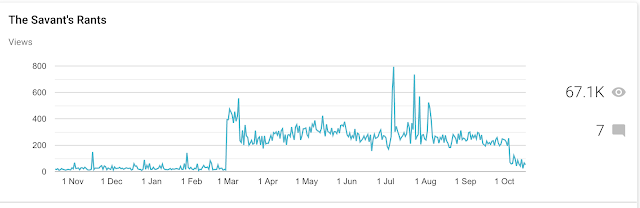
The pandemic has caught all of us up in different ways so it's been a while since I've looked at any of the T2k material I've created and written about on this blog. I was surprised when I came back after about a year to post a player summary for my current 5E group about the Iron Kingdoms, to see that this site has been accessed a *lot* more times than I expected, more than my other RPG blog

So I may have felt like I was still on my own down here in the antipodes, but it was a welcome surprise to find that in March this year, my site has become wildly more popular than previously, with particular popularity in July and August as well which is unprecedented.


Thank you all for your interest in my humble little blog of rantings!

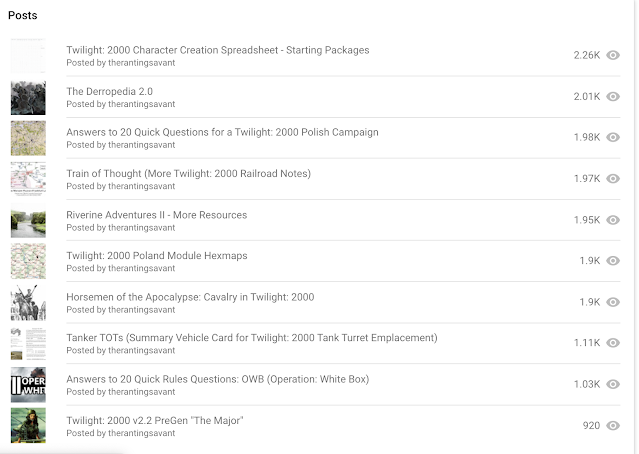
I must say I'm a bit lost as to why as I've been so caught up with life and work that I hadn't been following along with the community much and seem to have missed something... so I had a look at the Top 10 posts accessed in the last 6 months to get some idea of where the interest lay:


Top 10 Posts April to October 2021

So it seems pretty clear, with 7/10 of the top posts directly T2k related, that the interest is likely related to the recent launch of the 4th edition and perhaps people's reactions to (or against that). I'm quite proud of some of the articles in this list, so good to see people are finding them useful.

I am however curious why they are being accessed - whether they are being accessed for use in the new 4th edition or rather being used to support people playing the earlier editions. As noted above, leave a comment on what you have found useful and preferably why. Also if you have any ideas to shed on the site's sudden popularity I'd appreciate it.

As to the other three posts:

So when I do get my boxed set, I'll be returning to revise and expand on my existing T2k articles.

I'll compare the v2.2 mechanics of my older articles and the new 4th edition mechanical interpretations of the setting: character generation, iconic pre-generated NPCs, the Polish campaign and hex maps, trains, cavalry, and of course TOTs. OK maybe some new articles as well, eh? 

Should be fun, I'm looking forward to it.


Tu N'es Pas Tout Seul... Merci!

Oh last, but definitely not least comment. 

Thank you to all you viewers in France.!

Whoever you are and regardless of why because this was a very unexpected audience metric.

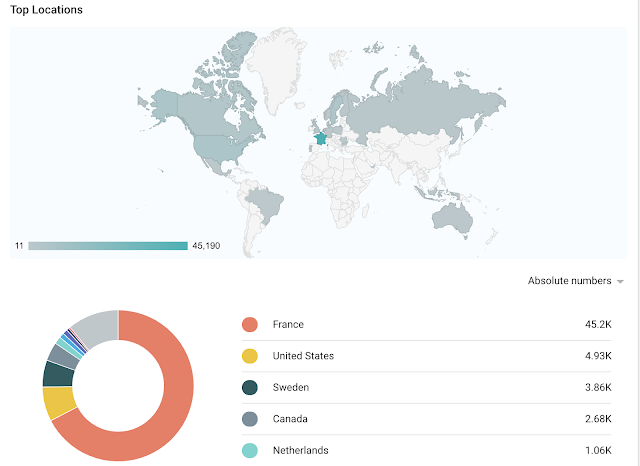
It seems this blog is now significantly more accessed from France than elsewhere by almost an order of magnitude. I really don't understand why to be honest, but although I can understand the content being popular in North America and also Sweden, I'm not quite sure what the "French Connection" is exactly as nothing is in French (my schoolboy French is terrible, Google Translate to the rescue) and nothing on this blog is set in France, unlike my other blog

I'm not aware of French VPNs being suddenly popular either.


6 months of Audience by Origin

So I guess it's Viva La Apocalypse! 

Au revoir. 


Friday, September 10, 2021

Collected Riverine Resources & Modules (*Updated*)

This is a growing list which I'll add over time, and I welcome suggestions...
(this is a revision of an older original post with further initial ideas on riverine adventures)

The following RPG products provide useful material for a river-borne campaign, some have formal reviews or I have discussed / may end up discussing in separate posts as required.

Rivers and River Encounters PDF

    This excellent resource is really the only one of its type in terms of being a general treatise on riverine encounters.

Death on the Reik (WFRP adventure)

    • River Life of the Empire booklet (WFRP 1e) - the essential resource 
    • The Enemy Within: a Companion (TEWAC, fan creation) has a section for DotR
    • My "River Life Encounter Generator" based on DotR1e (Google Docs spreadsheet)
  • "Chapter II: Life & Death on the Reik" (WFRP Companion 2e)
  • The Cubicle 7 version of WFRP / 4th edition has a revision of The Enemy Within including:

Other notable riverine adventures:

  • Rivers of Blood (DUNGEON #89) - Slavic riverine adventures why not?
  • Dolm River (Labyrinth Lord) - somewhat silly if truth be told but hey, it's OSR and Bryce rates it LOL...


The following threads and articles/posts are also of interest:

Saturday, August 10, 2019

Riverine Adventures II - More Resources

I'm taking a break from developing Twilight: 2000 material, returning to more generic RPG topics and back to a returning interest of mine - rivers and waterways. I've come across a couple of interesting products due soon, a recent PDF resource and a couple of useful articles and an alternate map approach (maps here) that I think make for good resources for riverine / waterway adventures.


Icelandic River (from Free Images)


Saturday, February 9, 2019

The Lower Vistula: Plock to Torun (Twilight: 2000 Further Riverine Adventures)

This is one of a possible series of posts detailing a gazetteer of a section of the "Lower Vistula", the stretch of the river *beyond* Warsaw to its mouth at the gulf near Gdansk. I've detailed the second section stretching from beyond Plock to before Torun because it's simpler than the first 100km or so from Praga in Warsaw and I found it interesting as a test of concept.

It's also the section directly north of the "Escape from Kalisz" map - reachable by a group using my "Amphibious Start" suggestion or for the remnants of the US 5th Division's 3-11 Battalion aka "the Ghosts of Kutno" (See below). Initial Soviet presence is low, making it a viable area to explore for a starting party although an inevitable showdown with the 96th Cavalry Division based in Torun is foreshadowed...

A typical stretch of the Lower Vistula

Section 2: Plock to Torun


Distance: 100 km
Channel depth: 4m or deeper
River width: up to 2 km between Plock and Włocławek, otherwise 1 km
Towns and landmarks: Gostynin, Gostynin-Włocławek Landscape Park, Włocławek Reservoir, Dobrzyn nad Wisla, Włocławek, Kowal, Lipno, Bobrowniki, Chiechocenek, Radziejow, Sluzewo, Chelmza.


Hexmap Detail of 2nd Lower Vistula Section - Plock to Torun
(derived from Jed McClure's Polish Sandbox Hexmaps)

Description: the upper part of this section of the river consists of the large 2km wide and 58km long Wloclawek Reservoir (Polish: Jezioro Wloclawskie) in the east behind the dam and serviceable lock at Wloclawec bordered on the south by the relative refuge of the Gostynin-Włocławek Landscape Park (see below). Ice build up and ice floes in the reservoir section can be a significant problem in the Winter months, although the last few years since the outbreak of war have not presented major difficulties yet.

The further stretch of river below the barrage until Torun conforms to the usual meandering and sandbank prone nature of the majority of the Vistula, but is mostly navigable by larger river ships than the upper reaches beyond Warsaw. Both the reservoir and the landscape park provide the villagers on the southern bank with relative safety from the troops moving through the area, as their large areas make it difficult for troops to harass the civilians who use their river-borne craft or the forested terrain to retreat to.

The wide reservoir between Plock and Wloclawek is relatively peaceful and picturesque, with a notable absence of regular troops or marauders other than the occasional lost river pirate boat from the remnants of the Korsarz of Warsaw (see PotV, pages 33-34). By contrast, the active forces further downstream are the patrols and convoys of the Soviet 96th Cavalry Division stretched along the road south of the river between the ruins of Wloclawec and their base in Torun (shared with the Soviet 22nd Cavalry Army HQ) and to the east along the railroad as far as Lipno. Forces south of the river will initially be on the lookout for remnants of the US 5th Infantry Division, but their interest will have fallen off as Winter approaches.

As Winter approaches, the small troop of 300 men from the Soviet 89th Cavalry Division based in Sompolno and the south stop following orders from Torun and begin to move eastwards to ultimately winter in the small town of Kowal. The nearby Soviet 43rd Cavalry Division remains with their attention to the north, based in and around their cantonment near the city of Grudziadz, controlling the two bridges over the Vistula in a face-off with the 2nd Polish Free Legion.

Encounter Tables


See later post for revised Encounter Tables...

Gostynin


This small town of about 200 inhabitants lies at the south of the landscape park on the road from Plock to Kutno and was bypassed by the recent fighting between elements of the US 5th Infantry Division and 1st Brigade and the Soviet 89th Cavalry Division. The wary villagers hunt through the woods nearby and have secreted several small caches of ammunition, supplies and food in preparation for the Winter and a retreat into the landscape park if harassed. If treated with civility they may assist American troops by showing them the paths and camping areas of the park.

Gostynin-Włocławek Landscape Park


Like other landscape parks, this area has relatively abundant wildlife including deer, wolves and particularly beavers around the multiple small lakes scattered through the area, allowing for reasonable fishing (and grenade fishing). Like the Kampinos Landscape Park to the east, the woods have overgrown and are now starting to reach up to the nearby towns and ruins. A small network of canals runs through the park, flowing into the narrow Zuzanka Canal that runs parallel to the Vistula for several kilometres, passing through Włocławek and opening into the main river at Port Letni. Encounter checks here result in animals more often (replace one of the Group results with Animal instead), making the park an excellent location for supplementary hunting for food.

Wloclawek Reservoir


The largest man-made body of water in Poland, stretching over 40km and almost 2km wide, this artificial lake hosts a small northern branch of the Czolno Lud, the waterborne civilian community of the Vistula. The majority of the two dozen boats are sail powered, although small alcohol powered motor launches form a part of many family flotillas. Moored about 10km downstream of Plock in the centre of the stream is an artificial island consisting of six tow barges with wooden houses and moorings that the river folk use as both a trade hub and neutral zone for discussions. The central barge mounts a modified 82mm Vasilek mortar that has sufficient range to enable shore bombardment as a deterrent against shorebound enemies.

Dobryzn nad Wisla


This small village of several families (less than 20 people) has retreated from the main town to makeshift dwellings and small fields within the ruins of the medieval Dobryzn Order castle on a cliff overlooking the reservoir just west of the old boating club. The families operate two small sailboats for fishing and trade their excess grain and distilled fuel with their relatives in the northern ranging boats of the Czolno Lud (see above and PotV, p 34-35) and the riverside settlement of Nowy Wloclawec on the outskirts of the ruins of Włocławek further downstream.

Kutno


See Escape from Kalisz, p94 - the scene of the fighting that annihilated the US 3-11 Battalion, the town is mostly ruined, with a handful of embittered and insular survivors returning from the woods to the south where they had fled. It marks the central point of Poland and is not only a major road junction near the was to be future Autostrada A1, but also the junction for the main railway lines (Poznan-Warsaw, Lodz-Torun, and another line leading northeast to Plock) and major passenger and freight rail stations. The agroindustrial park to the east surrounding the military garrison even has it's own rail sidings in reasonable repair.

Krosniewice


See Escape from Kalisz, p93 - a half-dozen US 5th Division survivors (of the 1st Brigade's 3-11 Battalion) are being sheltered in the town by the villagers, who are sympathetic to the Americans and share no love for the Soviet 6th Cavalry Division's 2nd Battalion that passed through mopping up the US remnants.

Alternate Start: The Ghosts of Kutno 
Following the fighting in Kutno, the Soviet 96th CD wiped out most of the US 5th Infantry Division's 3-11 Battalion, leaving a few scattered survivors in the area ie. Hexes 6913, 7013 & 7014 (Krosniewice and woods to the south respectively) and Hex 7113 (woods south of Kutno itself). Although likely starting without horses or heavy vehicles (either destroyed in the fighting or potentially captured and cached without fuel by the Soviets), this scenario provides a potential "alternate start" to the default EfK start (Hexes 6818 or 6618). Finding and then recovering the 3-11 battalion's last surviving vehicles (usual starting options or even a worn M2A2 Bradley needing significant repairs) may make an interesting kick-off, allowing the group to strike north off-road to an initial refuge in the landscape park by nightfall or else drive directly east about 130km along the secondary roads and reach Warsaw in a day - if they can scrounge enough parts and fuel from the less than friendly villagers... 

The Ruins of Włocławek


The Bridge over the Vistula at Wloclawec

This old Pomeranian city has lain abandoned and in ruins since the early days of the war, little more than a mass of rubble stretching along the southern bank of the Vistula. The truss road bridge across to the northern suburb of Suszyce, the 620m long Edward Smigly-Rydz Bridge, remains intact and provides reasonable clearance for most river-going vessels.

For encounters in the Wloclawec ruins, use the "Moving Through the Ruins" rules from Ruins of Warsaw, pages 9-10, with any Troops representing cavalrymen of the Soviet 96th, and any Marauders being deserters from the same unit. Civilians will be scroungers from the riverside settlement of Nowy Włocławek (see below).

The impressive upstream dam and barrage across the Vistula with its still serviceable lock were completed in 1970. During the initial exchanges when the city was devastated, the hydroelectric plant was targeted specifically and lies with the road broken and the river cascading through the resulting rubble. There is a troop of 15 cavalrymen from the Soviet 96th Cavalry Division guarding the southern end of the bridge, assessing it for whether it can be readily repaired by the division's engineers currently stationed in Torun.

Unlocking the Lock 
Currently the lock is set to the lower level, making passage downstream from Plock impossible without restoring it to working order. The northernmost 26.7 mW hydroelectric turbine may be salvageable with the correct parts (Rare, likely only available in Krakow or similar) and several days of repair requiring multiple skills (FOR Construction, Electronics and Mechanics checks, 2 days spent on each). The lock itself just needs minor mechanical repairs (Mechanic: DIFF, 2 periods) and to be hooked up to at least a 100 kW generator or the turbine to restore it to operational status, allowing large vessels to pass through. 
The Włocławek Dam, Barrage & Hydroelectric Plant
(original image adjusted to sepia tone)

Nowy Włocławek is the riverine settlement of survivors near the former suburb of Rybnica that has been established by the survivors of the main city and some of the local militia. Nestled in the ruins of the industrial park to the east of the main city, the survivors have reclaimed fields amidst the rubble in relative safety, surrounded by a dense belt of twisted metal and concrete that acts as a barricade. Scrounging parties from the settlement venture into the western ruins frequently, even as far as the ANWIL industrial park.

The formerly exclusive southern suburb of Michelin & Mielcin nestled in the woods is now one of the main staging areas of the rear echelon of Soviet 96th Cavalry Division (1400 men) including a small corps of engineers, stretched out in various convoys along the Torun to Wloclawek road to the west of the ruins. A small detachment of former airmen drafted as infantry when their planes were downed due to fuel shortage is refurbishing the nearby Krusyn-Wloclawek airfield and its Aeroclub facilities with a view to adding the recon capabilities of the half-dozen pre-War microlights cached in the hangars there (see Airlords of the Ozarks, pages 24-27 for details on these aircraft).

The pre-War ANWIL industrial park to the northwest has been similarly bombed and shelled into uninhabited ruins, although the rail lines leading from Torun that pass through to the south remain serviceable for the most part and are beginning to see usage by the mostly horse-drawn rail convoys of the 96th.

Kowal


Initially unoccupied in Autumn, by Winter this becomes the camp for the remnant Soviet 89th Cavalry Division that has withdrawn from the area they occupied around Konin, Kolo, Turek and their HQ at Sompolno after the defeat of the US 5th Infantry Division on 20th July. The Americans passed through this town briefly on their offensive but caused little hardship compared to Colonel Mikhaylov's 300 Soviet cavalry and their mounts demanding daily food - the villagers are resigned to waiting out the winter and hope to see the cavalry troop continue their journey eastwards in the spring.


Lipno


Straddling the railway line from Torun to Warsaw, this town of several hundred inhabitants helps provide food for the 96th Cavalry Division based in Torun. The locals have successfully converted the local Miejski Park to fertile fields and have managed to produce excess food to trade. A small detachment of a dozen cavalry troopers from the 96th with a rail-mounted BRDM-4 guard the railway station from which they ship grain to the divisional HQ a day's journey to the northwest, the rail carts pulled by an old BRDM-1 scout car also converted with rail wheels.


Bobrowniki


This small village on the northern bank with ruins of a Teutonic castle near the shore now lies abandoned. Two disused power lines cross from 100m tall pylons on either side of the river, the first set several hundred metres to the south of the village.  Although not electrified, some of the lines from the northeastern pylon have broken at the southern end and drape across the foreshore and into the river creating a potential obstacle for propellor craft.

Who Watches the Watchers? 
The Soviet 96th Cavalry Division has established an observation post near the top of the Bobrowniki tower, allowing the three observers with telescopic equipment stationed here to see almost 30km away to the horizon on a clear day with appropriate equipment - this effectively covers Hexes 6810, 6811 and 6910 ie the whole stretch of river from Wloclawec to Torun and it's suburbs and as far as the town of Lipno and the connecting railroad to the northeast and north. Specific details may be difficulty to make out but troop movements are easy enough to discern. The team have an advanced radio patched into an array at the top of the pylon that reaches to the HQ at Torun and the staging area in the wooded suburb of Michelin to the south of Wloclawec. The observation platform is unarmoured and reached by a single ladder, but does have a PK machinegun mounted on the corner furthest from the river to cover approaches to the post.

Radziejow


Now a small town of fewer than 100 civilians on the crossroads of the road from Sompolno to Torun and Wloclawec to Inowroclaw, the town's old hospital acts as the town centre and is still partly functioning through the use of a small generator, although the village is very low on necessary medical supplies due to "donations" to the passing military forces. The nearby Głuszyńskie Lake normally provides excellent fishing, although grenade fishing by the Soviet 89th Cavalry Division on their way south from Torun to the Kalisz area has depleted the local stocks much to the annoyance of the locals.


Ciechocenek


Mostly known through the ages for its curative salt springs, this town of about a hundred villagers now assists with food supply for the nearby Soviet cavalry forces in Torun, its parks converted into fields to supply the troops via horse-drawn rail convoys. In the easternmost Sosnowy Park, a field hospital for the cavalry division has been set up, flanked by the town's old hospitals with only a few MPs stationed as security.

Sluzewo


This hamlet of only 3 families about a day's return travel on foot from Torun lies just a short distance southwest of the Aleksandrów Kujawski Railway station and the rail cart convoys of the 96th Cavalry Division. Outside the town limits, stretching for about 20km towards Torun is the old artillery training ground, seeded with many unexploded shells (see page 10 of Ruins of Warsaw for suggested rules for unexploded ordnance) and old wrecked hulls once used for targeting practice.

The locals know the dangerous area very well and have several caches hidden amidst the dangerous area. One of the men can lead those willing to pay a price along the hidden path through the fields to the cellars beneath the old Torun Fortress.

Chelmza


The Soviet 43rd Cavalry Division has it's rear echelon in this small town on the shore of Lake Chełmżyńskie. With less than two hundred villagers, the town produces enough food to be self-sufficient, although the quartering of the rear echelon troops has put a strain on their stores. Rail carts drawn by horses connect the supply dumps with the force at Grudziadz to the north.


Note: details of the Soviet-occupied city of Torun will be presented in a separate section.


Monday, January 28, 2019

I've Been Working on (Maps of) the Railroad (Initial Thoughts on Train travel in Twilight: 2000)

Aside from the river travel options in "Pirates of the Vistula", the possibility of overland rail travel by converted steam engine as presented in "Going Home" has always interested me and makes for a unique closing chapter to the default starting campaign for T2k v1.0. I have various thoughts on this option, but first I'd like to begin with looking at the initial Kalisz area and piece together some of the thoughts that strike me when I look at the disconnected maps presented in the various supplements.

Note: the maps contain some *SPOILERS* for the module...

Sunday, December 16, 2018

A River Runs Through It... Twilight: 2000 Amphibious Start

In the original "Escape from Kalisz" scenario, there is an explicit setup meant to drive the characters in a southwards direction (towards Krakow and/or Silesia) due to the initial placement of the Soviet forces and the natural geographic features eg the unfordable Warta River. This post explores an option of a more northerly route, extrapolating on the potential if the characters start with or readily acquire an amphibious vehicle or vehicles.


Northern Kalisz Escape Route map circa 20th July 2000 (spoilers)

So let's imagine the characters start with just a M113 tracked APC. Probably an M113A3 to be exact (T2k v2.2, page 74). In the woods to the northeast of Kalisz, south of the Turek-Uniejow road and east of the Warta as shown in the above map.

Compare to a group travelling with a mixture of a couple of HumVees, motorcycles, and/or a few trucks (eg "deuce-and-a-half" and/or a 5-ton truck/tanker) perhaps converted into "gun trucks" this opens up an interesting option of (albeit somewhat limited) amphibious capability, and it's the river crossing capability that allows for the potential of a different departure route for an Escape from Kalisz campaign...

1) Northeast, straight towards Warsaw in fact via Kutno then Lowice, bypassing Krakow and the Vistula completely for a segway directly into the Ruins of Warsaw supplement arriving in the west near the road through the suburbs Srodmiescle, Mirow and Mokotow. 
2) West or Northwest, either along the Warta westwards directly to the Oder or else northwards following the canal near Konin that leads to the Notec via the Bydoszcz (Bromberg) lock complex and then again onwards to the Oder and the more friendly territory of Germany... (see Going Home for useful details).

A campaign involving a fully amphibious movement capable party ie. *all* vehicles (or a solo vehicle without trucks or a trailer) capable of crossing or traveling along stretches of rivers would therefore be different to a group with a wheeled LAV-25 and a Hum Vee, like the iconic T2k v1.0 group used for play examples in the original boxed set.

Note: this post uses some variant from canon details drawn from Paul Mulcahy's "Tracked APCs - US" page. Unless otherwise noted however I refer to the "base" vehicles from the core book or the American Combat Vehicle Handbook (page 22 for the M113, page 26 for the LAV-25) .

Why an M113, not just a LAV-25?


Mainly because I like the idea of a variation to the example group and using the M113 - it's always been and will likely remain such an iconic vehicle from its inception and in widespread use in its many variants and upgrades. The image below shows a later modification circa ~1999 which enables "sea to shore" capability that may not have come into production in the Twilight World:

M113A3 "AmphGavin" fitted with "AAV-like" nose for sea to shore travel


Superficially, the LAV-25 wheeled infantry fighting vehicle occupies a similar starting vehicle "slot" (accessible only to a party of 4 or more on a roll of "10" on 2D6 as opposed to a "11" on 2D6) and has similar capabilities - it's amphibious, similar Weight (11 or 12 tonnes), has slightly better Fuel Consumption (base 90 vs 120), and has a faster Combat Move and a better road Travel Move than the tracked APC whereas their off-road Travel Move 85 is actually equivalent. The M113 has full radiological shielding and headlights instead of just the enclosed status and passive IR of the LAV-25.

Both vehicles have the same Load (2 tonnes, but an extra 10% strapped to the outside as both armoured), and reasonable armour protection although the LAV-25 is slightly less protected than the M113. Given a medium still weighs 2 tonnes, for independent travel ie. not needing a support vehicle mounted still / tanker such as perhaps the M-548 below, either vehicle sacrifices their whole internal carrying capacity.

Unfortunately there don't appear to be any real amphibious US or NATO trailers apart from the small 340kg capacity M-100 jeep trailer from Paul Mulcahy's website, but I'm unsure whether this could be adapted to be towed in water as both the APC and the wheeled IFV sit very low in the water anyway. Any trailer cargo would have to be shifted to the outside of the armoured vehicle for a river crossing and the trailer abandoned.

Designed for carrying a troop complement, each option has enough space to carry a small beginning party - the LAV-25 can carry a total of 9 characters, but needs a crew of 3 compared to an M113 ability to transport 11 characters beyond the base crew of driver and commander. That's 4 extra characters for an M113 equipped group, which I think is a significant positive - the M113 really is an APC and it shows in this capacity for a starting campaign, readily allowing for dependents and non-combatants.

Sure, if you're looking for firepower the LAV-25 carries a 25mm autocannon in a turret used on the Bradley (as does the Dutch/Belgium AIFV variant of the M113 or the improved M115A1 AACV) with Fire Control +1 and Basic stabilization (no penalty while moving at normal speed), but it has only a lighter co-axial MAG MG.  The basic M113 variants lacks this autocannon, but has the advantage of the heavier 2HB MG on the M113 that can be readily dismounted onto a NHT and is unlikely to run into ammunition issues (the LAV-25 has a base of only 630 rounds for it's 25mm, after which it's main gun is useless unless this uncommon NATO round can be bought or scrounged in useful quantities. Tanks in the starting scenario are rare and best avoided or dealt with by anti-tank missiles IMO, so I feel that while the autocannon may be an early advantage or deterrent, it's role reduces or expires as the campaign progresses.

The M113 does lack the (6) firing ports of the LAV-25, but it has not only rear access but also top deck access for all the passengers with 2 additional heavy weapons mounts (and capacity to jury-rig more with the right tools and character Assets). This allows the APC to work more like a tracked "gun truck" ("gun track"?) rather than just a "battle taxi" as while the gunners are less protected, for combats with lighter "soft-skinned" vehicles or troops, the whole passenger troop can contribute if the rear deck doors are opened. The ACAV style modifications from the Vietnam era and/or applique armour kit (see Paul's website for suggested details) add to the survivability, as does the AACV option (American Combat Vehicle Handbook, page 23). To me this is more in keeping with my concept of vehicle use and travel in a beginning Poland campaign - patched up and field modified older equipment desperately maintained.

In the late 1960s, a waterjet propulsion system was developed for amphibious operations. This allowed the M-113A1 on which it was tested to roughly double its swimming speed and greatly increase waterborne mobility. The waterjets were steered by vanes. Air was sucked in from the top of the waterjet modules and pushed out under the water level to form the jets. Ballast was added in the front to ensure stability. The waterjet system was, however, decided against by the Army. In game terms, adding a waterjet propulsion system adds 300 kg to the weight of the vehicle (which is subtracted from the M-113s cargo capacity) and adds $4000 to the cost of the vehicle. 
- Paul Mulcahy's Twilight 2000 website

M-548 as 5-ton "truck" variant amphibious support option

Similar in concept to the M113 (and cheaper at around $50,000 base cost depending on whether using an official source (American Combat Vehicle Handbook, page 10) or the "Heavy Unarmoured Vehicle" section of Paul's website) is the M-548 "heavy track" 5-ton amphibious cargo carrier:


Even if not rolled as an option (equivalent to a 5-ton truck, ie a roll of an "8" or "9" on 2D6) it's low price makes it readily accessible as a secondary starting amphibious cargo vehicle (particularly if reduced by accepting a Wear value of 2 or more ie. only $25,000 or even less, potentially affordable by a starting group of 4+ characters). 

It's main drawcard is it's considerable cargo capacity of 6 tons - easily enough to accomodate a medium still (2 tonnes) for itself and the M113, with perhaps a 1000L tank to accomodate spare fuel supplies and enough room left over for other equipment. Offset against this is that while it has comparable base Fuel Consumption (140 vs 120)  it is somewhat slower than the M113 (off-road travel only 70), "soft-skinned" (unarmoured), somewhat unreliably amphibious, and has no significant radiological shielding or passive IR capability. It does come with the same M2HB machinegun on a ring mount shared with it's M113 cousin however, allowing for consolidation of ammunition supplies with the APC.

Optionally, at the loss of the reliability of amphibious capability (reflected by the need for a Skill check to not founder when used at a river), it could be upgraded into a solo "gun track" similar to the base conversions of the "deuce-and-a-half" and 5-ton "gun trucks" from Challenge Magazine #55 (pages 6-8). This "gun track" field improvisation adds steel plate armor (equivalent to HF / HS / HR: 4 level) and at least 2 additional weapons mounts, but at the cost of dropping the speed and decreasing the available Load to only 4 tons. For a smaller group interested more in gear than personnel, this less glamorous option could be an interesting variant starting vehicle option.

A Marines Variant?


Rather than a M113A3 (or modified "gun track" M-548), a group somehow linked to the Marines or with a few Marine characters may choose to use a so-called "Amtrac" AAVP7A1 or variant instead - a roughly equivalent in price and capability APC exclusive to their armed forces branch with an increased personnel carrying capacity, load and some sea-going capability, shown here cruising down a river:

AAVP9 Tracked Amphibious Vehicle crossing a river

AAVP9: The AAVP9 is an advanced version of the AAVP7A1 amphibious armoured personnel carrier, entering service in the early 1990's. A 40mm AGL and M2HB MG combination is mounted in a small cupola on the right front hull deck, and there are two smaller hatches for the driver and vehicle commander on the left front hull deck. The rear deck contains two large doors for disembarking personnel, and the rear has a ramp/door which can be lowered as well. The vehicle is fully amphibious. The 40mm AGL is identical in performance and characteristics to the Mark 19.
Price: $80,000 (R/R) RF + 15 Armament: 40mm AGL, M2HB MG Ammo: 350 x 40mm Tr Move: 120/70 Com Move: 40/30 Fuel Cap: 360 Fuel Cons: 120 Fuel Type: D, A Load: 4 tons Veh Wt: 18 tons Crew: 2 + 22 Mnt: 6; page 30 US Army Vehicle Guide (v1.0) or page 25 American Combat Vehicle Guide (v2.2).
As you can see from the above, the "Amtrac" is all around better armed and armoured, reliably amphibious with some sea-going capacity, has more crew protection for it's crew operated weapons and has a bigger cargo capacity, overcoming most of the limitations of the M113A3 for a similar core rules cost. Although slightly slower it has not only greater personnel capacity (a commander and an extra 11 characters beyond the M113) but also the advantage of carrying not only a medium still but also a remaining 2 tonnes of internal cargo and 1800kg of external cargo strapped to the outside.

To me the "Amtrac" has a big personality - it's rare in Poland and distinctively American, can operate independently and I think has the potential to become almost a separate "vehicle character" in it's own right or legend in itself amongst the remaining Soviet forces in the area. Discreet? Not so much - it's very uniqueness makes it stand out and marks it as a potential trophy to enemies.

Explaining Marine character(s) presence and such a signature vehicle with the remnants of the US 5th Division forces in central Poland may require some back-story explanation but given the chaotic nature of the later stages of the Twilight War and the tendency for remnants of disrupted units to be incorporated into remaining units, it's a plausible beginning single vehicle option if somewhat higher powered.


Rules References


Addit: Wayne suggested the following relevant amphibious vehicle references from the v2.2 rules:

  • Page 213: Movement
  • Page 214: Swamping
  • Page 220: Penetration

"A referee that wants to allow amphibs, but not be used immediately in Escape From Kalisz, can add a few hull penetrations along with the Wear roll. The PCs could patch their amphib up later, but are quite busy at the moment."


Sunday, December 9, 2018

Europe's Navigable Waterways


So I came across this resource that I think is helpful for using rivers as a central element in RPGs - it's the UNECE interactive map of Europe's Navigable Waterways (click here for the PDF download but note it's at least a 2MB file when compressed to JPEG).

It's very, very detailed, and although the legend/key (in English, French, and Russian) doesn't appear in the above image, it's readily accessible in the bottom right of the PDF version.

Looked at from an overall perspective, the map shows the waterways by several characteristics:

  • Type (free-flowing river, canalised river, canal)
  • Class (regional vs international significance)

In addition, major local features are detailed such as:

  • Locks & Weirs (common)
  • Ship lifts (rare)
  • Dams (those without locks)
  • Bridge maximum heights and minimum draught
  • Local restrictions (shallows)

Taken together with the basic geographical elevations outlining the relevant uplands and mountain ranges, this map suggests some interesting potential play options for a campaign (whether set in Europe in the "modern" period eg T2k v2.2 or in a "European" style fantasy world with steam level technology eg WFRP, or perhaps even the default 16th century time period suggested for LotFP).

Riverine play, whether adventures or in fact as a central element of a campaign, isn't featured as a major option in most campaigns - WFRP 1e Death on the Reik being perhaps the notable exception that proves the rule, and to a lesser extent the difficult to source GURPS Riverworld.

This map, although in many ways just a technical representation, to me opens up the possibilities of transcontinental riverborne and canal centred campaigns.

Thursday, November 22, 2018

Draft Waterway Characteristics for Riverine Encounters


The following is my first attempt at a simple D6 based scale for potential encounters on a river. The scales give the "chances" of a particular occurrence, either a Hazard or an Encounter - the remaining "chances" are by default a result of No Encounter. 

So let's start with some definitions I think:
A waterway is any navigable body of water. Broad distinctions are useful to avoid ambiguity, and disambiguation will be of varying importance depending on the nuance of the equivalent word in other languages. 
A first distinction is necessary between maritime shipping routes and waterways used by inland water craft. Maritime shipping routes cross oceans and seas, and some lakes, where navigability is assumed, and no engineering is required, except to provide the draft for deep-sea shipping to approach seaports (channels), or to provide a short cut across an isthmus; this is the function of ship canals. Dredged channels in the sea are not usually described as waterways.
So when we're talking about "riverine" encounters, we're really talking about waterways except when we're referring to those smaller rivers with significant cascades and rapids that can only be traversed by small canoes and portage (hauling the canoe overland around the water hazard). These are a special case and might actually be better treated using encounters based on the surrounding terrain with hazards as set encounters or via a pointcrawl, but it's nearly always the exception that proves the rule.

In terms of Hazard (Danger), a stretch of waterway can either be:
  • Extreme - 4 in 6 chance of Hazard (only Desolate)
  • Treacherous - 3 in 6 chance of Hazard (cannot be Populated or Congested)
  • Hazardous - 2 in 6 chance of Hazard (cannot be Populated or Congested)
    • Choked - 2 in 6 chance of Hazard (only Congested)
  • Unimproved - 1 in 6 chance of Hazard
    • Ruined - 1 in 6 chance of Hazard 
  • Improved - 0 in 6 chance of Hazard (set-piece Hazards only, eg. canal)

From an Encounters perspective (Population), a stretch of waterway can be:
  • Floating City - 4 in 6 chance of Encounter (only Improved)
  • Congested - 3 in 6 chance of Encounter (cannot be Treacherous or Hazardous)
  • Populated - 2 in 6 chance of Encounter (cannot be Treacherous or Hazardous)
  • Remote - 1 in 6 chance of Encounter
    • Wild - 1 in 6 chance of Encounter (animals only)
  • Desolate - 0 in 6 chance of Encounter (set-piece Encounters only)

Optional: at night, the Population drops one level unless "Wild" or "Desolate" already. "Remote" instead changes to "Wild" to reflect the lack of human encounters during the darker hours.

To create a more uneventful journey, substitute D8 or D10, but leave the scaled "chances" the same.


Sunday, November 4, 2018

Vistula Encounter Tables Analysis - the Character of a River


Apart from the random tables in Death on the Reik, the only usable riverine random encounter tables I've come across so far are those from the T2k adventure Pirates of the Vistula. Let's then have a look at the "General" Encounter tables for each of the 4 main sections of the stretch of the Vistula covered by the module to see what can we extrapolate:

Pirates of the Vistula General Encounter Tables 

Note: there are more specific tables for minor stretches of the river in the module, usually associated with the riverine towns or particular geographical areas, but I'm not going to analyse that here. Likewise, I'm not looking at the "Shore" section of the tables as the module notes these are intended for use in the hinterland sections when the party is exploring ashore, not for the riparian sections.     

Looking at these section River General Encounter tables, based on the distribution of a 2D6 roll, there are a few common features and associated probabilities:

  • 2 is always a Hazard 2.78%
  • 5-7 is always No Encounter 41.67%
  • 9-12 are always Hazards 27.78%

This accounts for ~73% of the "encounters", although effectively ~40% (~5/12 or ~4/10) are actually no encounter. Hazards as a group, however, are encountered at least 30% (4/12 or 3/10) of the time, which seems quite high on first thought, although I guess the Vistula could be considered "remote" and "unimproved" - if anything it could be considered "hazardous" (worse than "unimproved") due to the numerous ruined structures and other post-apocalyptic debris (more on different waterways in a later post, however). 

Two outcomes show some minor variability, but I'm unsure if this was intentional or not.

  • 3 is usually Hazard except for Section 2 (No Encounter) 5.56%
  • is No Encounter except Section 4 (Mud shoal) 8.33%

Both of these outcomes are relatively rare on a 2D6 distribution.

Only one of the outcomes has any real variability across the tables, resulting in "No Encounter" for the first and third sections of the river, alternating for the other 2 sections.

  • 8 is variable across sections (No encounter, Mud shoal or Boat) 13.89% 

It's this particular outcome that influences the tables given the high frequency on a 2D6 roll. This is effectively the "discretionary" outcome of the table, used to increase the probability of one of the three outcomes by about 10%, either as No Encounter, Hazard or Encounter.

Three Examples 

From herein the maths is not exact and I'm rounding to 5% (1 in 20) intentionally here for ease.

Let's assume for a first example that the 8 result outcome is an Encounter for the set of calculations below. So the base table without the variability then roughly leaves the base chance of outcome as:

  • No Encounter     ~50%
  • Hazard                ~35%
  • Encounter           ~15%  

Using these estimates, a party travelling down the Vistula will note that hazards are about twice as common as actual encounters with humans. As per the module, checks are done for the morning and the evening when travelling (unlike DotR, there is no default option for night travel or a separate table), which results in the following combinations for each day:

  • A Hazard 36%
  • Uneventful 25%
  • An Encounter 16%
  • 2 Hazards 12%
  • An Encounter & a Hazard 10%
  • 2 Encounters 2%

This means there's about a ~60% chance (6 in 10) each day of at least one Hazard, a 28% chance (3 in 10) of at least one Encounter, and a 25% chance (1 in 4) of an Uneventful journey each day.

In a second example, let's assume the 8 result is a "No Encounter" ie. a less populated region.

So the base table without the variability then roughly leaves the base chance of outcome as:

  • No Encounter     ~60%
  • Hazard                ~35%
  • Encounter             ~5%  

With these estimates, a party travelling down the Vistula will note that hazards are much more common than actual encounters with humans. As per the module, checks are done for the morning and the evening when travelling (unlike DotR, there is no default option for night travel or a separate table), which results in the following combinations for each day:

  • A Hazard 42%
  • Uneventful 36%
  • An Encounter 10%
  • 2 Hazards 12%
  • An Encounter & a Hazard 4%
  • 2 Encounters 0%

This means there's about a ~60% chance (6 in 10) each day of at least one Hazard, a 14% chance (1 in 10) of at least one Encounter, and a 36% chance (4 in 10) of an Uneventful journey each day.

In a third example, let's assume the 8 result is a "Hazard" ie. a treacherous stretch.

So the base table without the variability then roughly leaves the base chance of outcome as:

  • No Encounter     ~50%
  • Hazard                ~45%
  • Encounter             ~5%  

In this example party travelling down the Vistula will note that hazards are even more common than actual encounters with humans. As per the module, checks are done for the morning and the evening when travelling (unlike DotR, there is no default option for night travel or a separate table), which results in the following combinations for each day:

  • A Hazard 46%
  • Uneventful 25%
  • An Encounter 4%
  • 2 Hazards 20%
  • An Encounter & a Hazard 6%
  • 2 Encounters 0%

This means there's about a ~70% chance (7 in 10) each day of at least one Hazard, a 10% chance (1 in 10) of at least one Encounter, and a 25% chance (2 in 10) of an Uneventful journey each day.

An Alternate Distribution Method


Let's look at using an alternative "d4+d8 roll" distribution on the same table to generate a flatter distribution for the first example above (a result of 8 is an Encounter and reflects a 12.5% probability):

  • No Encounter     ~40%
  • Hazard                ~40%
  • Encounter           ~20%  

This is calculated using the "Anydice" website and its probabilities mapped from above.

This seems a lot neater somehow and is similar enough to the standard method - again Hazards are about twice as common as encounters with humans but equal to No Encounter and this results in the following distribution of probabilities:

  • A single Hazard 32%
  • 2 Hazards 16%
  • An Encounter & a Hazard 16%
  • An Encounter 16%
  • Uneventful 16%
  • 2 Encounters 4%

This second distribution then results in a 64% chance each day of at least one Hazard (4 in 6),  a 36% chance of at least one Encounter (2 in 6) and a 16% chance (1 in 6) of an uneventful journey for that day. The overlap of a Hazard and an Encounter is also neatly 16% (1 in 6). Even with the adjusted probabilities, a cruise down the Vistula is going to be quite eventful and full of hazards.

The other two examples result in an Encounter chance 10% and either No Encounter or Hazard of either 40% or 50% depending on what the result of the "8 outcome" is chosen to be. I won't work these out in full here, but they similarly give options for either a more desolate or treacherous stretch of river respectively.

Note: Interestingly, the 2 in 6 chance correlates with the chance of a random encounter (hazard or creature) in an OSR style game such as Labyrinth Lord for rivers (2 in d6), although the original rules suggest checking against this chance 2-3 times per day. This actually generates a much higher 46% chance (3 in 6) or 31% chance (2 in 6) of "No Encounter" each day (based on 2 and 3 rolls respectively). The split between Hazards and creature encounters isn't specified in older games, although traditionally early encounter tables were exclusively creature based.

Comparisons with the Reik


Using either distribution, these three examples provide significant variation from the base layout of the table but by extrapolation from the module as written, regardless of which stretch of the river is being travelled, a cruise down the Vistula is still going to require a lot of random obstacles dodging or debris clearing, with only infrequent stretches of an uninterrupted waterway and some occasional human encounters (river-borne or on the shore).

All this is without the set-piece encounters at narrows, townships and bridges (intact or ruined).

Compared to the stretch of the River Reik presented in Death on the Reik, with a calculated 30-40% encounter rate per check during the day (refer to the "River Life of the Empire" booklet), the Vistula is therefore much, much less busy but with a lot more potential hazards (the Reik has only a <10% calculated Hazard rate). This makes sense as the Reik is densely populated, highly patrolled and significantly improved and maintained without many natural hazards, whereas the post-WW3 version of the Vistula portrayed in the module is only sparsely settled, virtually unpatrolled (except for the Korsarz near Warsaw) and not only littered with ruined structures (bridges and docks) but seems intrinsically treacherous by nature (mud shoals, sandbars and rocks). 

The two rivers have vastly different characters in terms of population, control and improvements and this is therefore appropriately reflected by their random encounter tables. They are not quite at the extremes but provide a good contrast at different ends of the spectrums of character.

I think this helps explain what makes each river feel different in terms of "personality".

Concluding Thoughts


So what then makes up a river's character?

Let's see if we can pick out some common themes from the analysis above. A river can be...

  1. Navigable vs Unavigable
  2. Populated vs Remote
  3. Patrolled vs Unpatrolled
  4. Improved vs Unimproved
  5. Tame vs Hazardous

These dimensions should allow me to model a few key characteristics of rivers (as waterways ie navigable) that will help construct different riverine encounter tables going forward. 

For example, the upstream Utdoo section of the river winding through the Amedio in UK6 is:

  1. Unavigable
  2. Remote
  3. Unpatrolled
  4. Unimproved
  5. Tame

However, the Black River from Corvis to Merywyn in the Iron Kingdoms is likely:

  1. Navigable
  2. Neither Populated nor Remote
  3. Patrolled
  4. Unimproved
  5. Neither Tame nor Hazardous

It's a start in any case and something I'll pick up on in a later post...

Sunday, October 28, 2018

Crossranting: The Vistula, but with a Floating Tank (Twilight: 2000: Later Days)

But think with a tank parked on a barge at the bow...
We're a tiger out for a swim. Four mortars down in the belly of the barge, 3 MG positions on each side with a RPG in case of heavy trouble, and the T-72 weighing down the front end. The OT-64 parked toy-like beside it. On the tug we've got another 2 heavy machineguns and 2 mediums on the deck. Finally, the AT-4 anti-tank missile launcher on the roof of the bridge.  - Captain Katriona Paterson

Every now and again you stumble across something unexpectedly interesting on the web while looking for something else entirely and recently for me this was the output of Chris Csakany on his Twilight 2000: Later Days defunct blog (July 2011- March 2013).

Although I'd previously mapped out the first stretch of the Vistula from the module on a previous blog and summarised some of the encounter types, it's been difficult to find any other reasonable material for inspiration to create more generic riverine encounter tables with.

That is until now. 

There's a stretch of 8 game posts from #038 to #45 (Nov 2011 to March 2012) written by Chris (with help from his group of players) that covers the whole trip detailed in the Pirates of the Vistula module:

Addit: there are several additional posts beginning with "New Orders" covering the second trip the lower Vistula beyond Warsaw to Torun, setting up the rail journey to the port of Bremerhaven detailed in Going Home

It's written in character and flows quite well, but there's enough material to both develop an understanding of the play of the campaign they ran (they mounted a T-72 battle tank on the bow of the tug to somewhat hilarious and certainly deadly effect) but also for me to get some more generic ideas from for my riverine encounter ideas.

I'll mine it for some more ideas over the next few weeks, but looking over the original module there's a lot of encounters and hazards that could be readily adapted for a more "generic" riverine adventure and I like the way the tables are set out in "stretches" and divided into "river" vs "Shore". I might even be able to mock up a random generator table or two...

The rest of the posts are quite interesting as well, covering the 5th Division remnant group as they work their way from the default start at Kalisz through to the T2k v1 American mainland adventures. The group even use the suggested strategy to flee immediately due south as an escape route that I mention in my T2k Campaign Start option post... 


Thursday, October 25, 2018

GURPS Riverworld - A Classic, But is it Any Good?

At last! I has it, my precious...
So I managed to track this classic down on eBay.

It's out of print, published 1990. Not even available in PDF.

Looks like it would have some interesting river adventure ideas, right?

Unfortunately not really...

See it's a *Riverworld* supplement.

Not a river (world) supplement as such.

So I'm a bit disappointed to be honest.

...

<gasp>

...

Yes I actually typed that.

Look it's actually really interesting and inspiring, even though I've only starting picking through selected sections of it looking for nuggets for the Indicara section of the AtG project that started all this...

That's not to say there aren't elements in this particular chapter that could be cannibalised for a generic river campaign, but I was hoping for some more procedurally generated elements for travel along the river that are related to the river itself. On reflection, there's actually not a lot of variation to the River or the actual Valley climate and geography except for near the Polar Sea and perhaps the occasional "narrows" sections. The picture low demonstrates a typical stretch of the River:

The Rivervalley (excerpt GURPS: Riverworld)


Most of the variety present along the river is actually cultural (created by the random mixture of predominant and then a secondary historical society sample), not topographical as such, and what I was really looking for was ideas for river travel eg hazards, encounters, varying conditions, unique locations etc. By it's nature, the whole river is navigable, which seems great for a riverborne campaign, but in many ways the river is quite, well... bland. There's vary little geographical variation to the cliff-flanked Valley itself and the River is broad and wide with a mostly gentle current.

The River, despite the capitalisation, doesn't really have a character of it's own.

And that's perhaps what I was looking for, hence my disappointment probably.

One of the characters in the first book, To Your Scattered Bodies Go, refers to the ability to be randomly teleported up and down the length of the River upon death as "the Suicide Express" and the train metaphor is perhaps apt - the River is indeed somewhat of a "railroad" in the way it geographically limits the riparine societies in a definitel linear fashion.

By contrast, the River Reik, from the Warhammer Fantasy setting, seems more alive with it's own character and distinct culture (including river gypsies, trade, canals and riverwardens). In the Riverworld setting however, despite the profusion of riparian societies and nations, there's really no distinct itinerant "riverborne" culture, which seems an oversight to me. 

Saving Grace?


Now Chapter 3: "Airships and Riverboats" does have a lot of great ideas and information to use for a riverine campaign or a steampunk styled campaign with airships, but many of the ideas are still locked into the "conceit" of the setting, that is by the overarching meta-plot and unique aspects of the Riverworld planet's geography.

Aspects of the canoe and riverboat descriptions are helpful, and I the airship rules are very detailed thankfully, which may be the unexpected saving grace for me given the effort I went to tracking down the print product in reasonable condition.

I admit I do love a good airship...